Imperialism and Global Migration Flows
How Western and European Imperialism Engineered and Distorted Global Migration Dynamics in Modern Times

Imperialism is the dominant engine of migration in modern times.1 In an age of apex predators extracting the natural resources and commanding the labor supply of the world economy, human mobility on a global scale has been driven by the structural demands of the imperial core, including the violent acquisition of slaves, the forced relocation of laborers, war recruiting in the colonies, the creation of refugees, and the reabsorption of colonial subjects by the metropoles. Global capital mobility and labor mobility both happen by “choice,” namely the choice of capitalists to organize the world economy on their own terms.
My understanding of imperialism has been shaped by many sources, including Marx and Lenin, but is chiefly influenced by the theorist Immanuel Wallerstein, whose world-systems approach divided the world into a core, periphery, and semi-periphery.2 For Wallerstein, the imperial core is defined by powerful nations with strong militaries and large corporations that extract value from the rest of the global economy by exploiting cheap labor and grabbing natural resources and raw materials for industrial manufacturing. In this sense, empire is conceptualized through its external extractive relations with other countries and civilizations, not its internal political systems and institutions.
The Roman Empire was an empire, but so is the United States, as it too has a rigid sphere of influence that it maintains through military and financial coercion. The United States has a larger military budget than the next five highest spenders, operates hundreds of military bases and installations around the world, extracts money from host nations to finance its military presence, places severe economic sanctions on those who challenge its authority, and leverages the adoption of the dollar as the world’s de facto reserve currency in order to borrow cheaply from other countries. Within this theoretical paradigm, it qualifies as an empire. Of course, empires have existed throughout history, but the biggest focus of this post will be Western imperialism in modern times since that has been the dominant core of the global system for centuries, although I should stress that it won’t be the exclusive focus, as various characters like the Ottoman Empire will also appear in the narrative. This critical Western core likely had the largest and most intense effect on global migration dynamics in human history, outside of natural disasters and ecological conditions, which are also absolutely essential for understanding global migration flows in history but will not be covered in this post.
When we talk about immigration and its underlying causes in popular discourse, we tend to overemphasize the motivations of those who are moving and the reasons for why they're going to a particular place, a kind of push-pull analysis that has become a staple in much of the literature and the media. They’re looking for work and economic opportunity. They wanted to flee from war. They didn’t want to live under a corrupt or tyrannical government. These are the kinds of ideas that people often repeat. Rarely do we bother to examine the structural factors that are driving these motivations. Why don’t they have economic opportunity at home? Why is their country perpetually mired in conflict and chaos? Who installed the corrupt government that’s depriving them of a decent life? In this post, I’m going to explain why this is the central framing we need to adopt if we ever hope to grapple with global migration dynamics in modern history, in addition to the downstream political and economic upheavals that these migrations may cause.
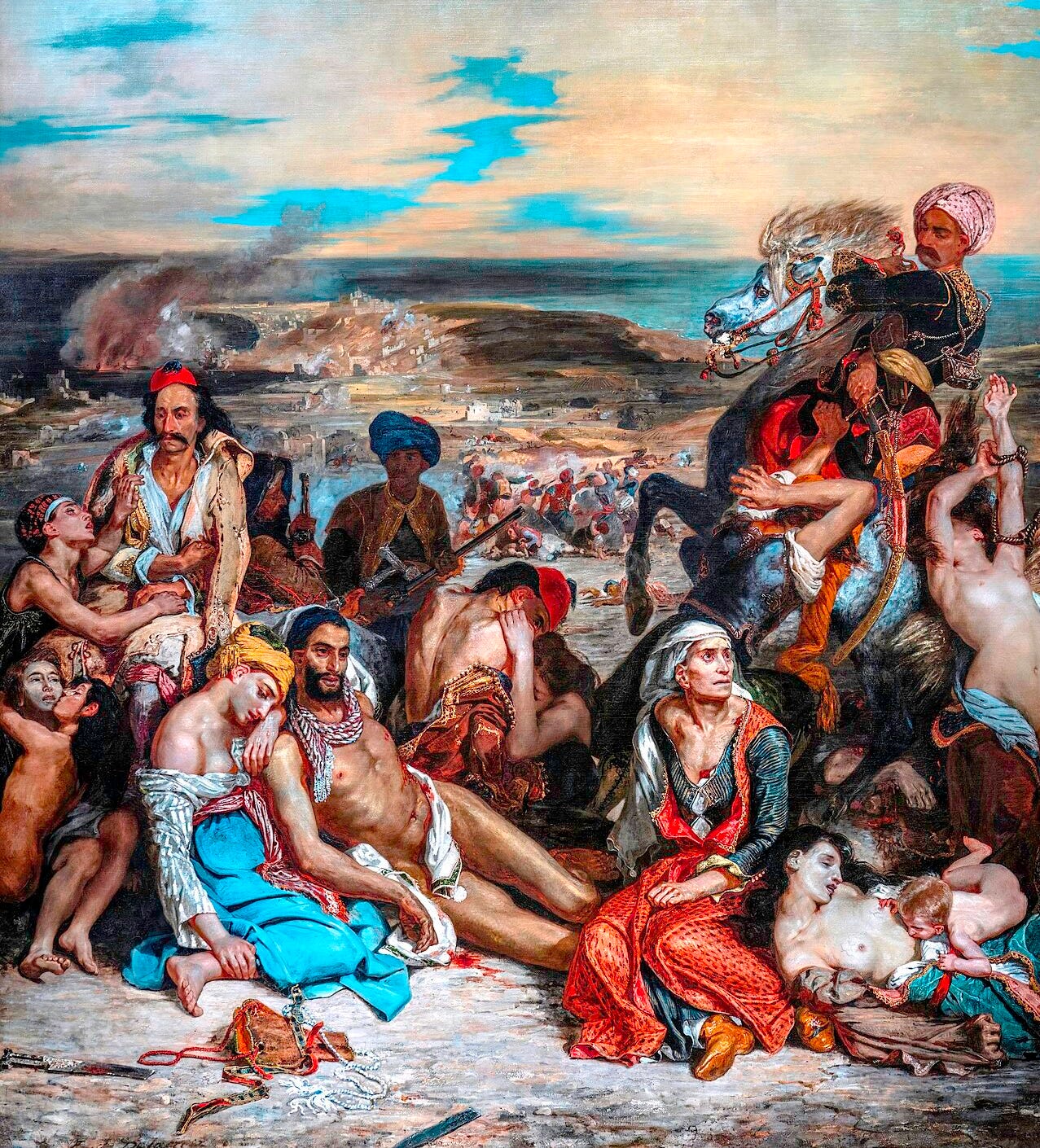
People don’t migrate simply because they want a better life. If that were the case, the entire world would be moving almost every other year. Modern populations move because they’re forced to do so by the broader imperatives and constraints of the global economy, which is controlled by dominant capital in the imperial core. Migration is the cost and result of imperial subjugation in whatever form it comes, be it through economic means or from outright warfare (see Figure 1). And even when the imperial core exploits the global labor arbitrage and finds cheap labor abroad, there always remain economic sectors in the imperial core itself that require a constant stream of cheap labor to remain profitable, like agriculture in the United States, a sector where half of all workers have traditionally been undocumented.3
Migration dynamics in the imperial core are important not simply because migrants provide a source of cheap labor for capital to exploit. Immigration can affect domestic politics and and economic institutions in profound ways. For capital, immigrants are both a source of cheap labor and a convenient scapegoat whenever it becomes necessary to divert and redirect popular working class anger away from the ruling classes. Housing is not expensive because of investors, monopolists, and bad regulations; it’s expensive because of all the illegal immigrants that came in! Wages for the working class aren’t low because capitalists are grabbing all the income; they’re low because we have to compete with illegal migrants! From the 19th century with the Chinese Exclusion Act to the present day with the likes of Trump and Farage, capitalists have always inflamed these kinds of tensions at critical moments of stress for the system. In that sense, migration provides a double function for capital accumulation: it provides cheap labor that keeps production costs down and it helps to divide and distract the working class, an essential precondition for ensuring the dominance of the capitalist class.
What I want to emphasize in this post is that the imperial and colonial policies of the Western core obviously shaped the migration dynamics of non-Western peoples, but also the migration dynamics of Westerners themselves, sometimes in ways that you might find surprising. We all know that places like Australia began as penal colonies where the British Empire sent domestic convicts for forced labor, but did you know that the Irish Famine was exacerbated by deliberate British neglect meant to heavily depopulate the island so the British aristocracy could grab more land? If you didn’t, then read on!
Modern Slavery and the Atlantic System
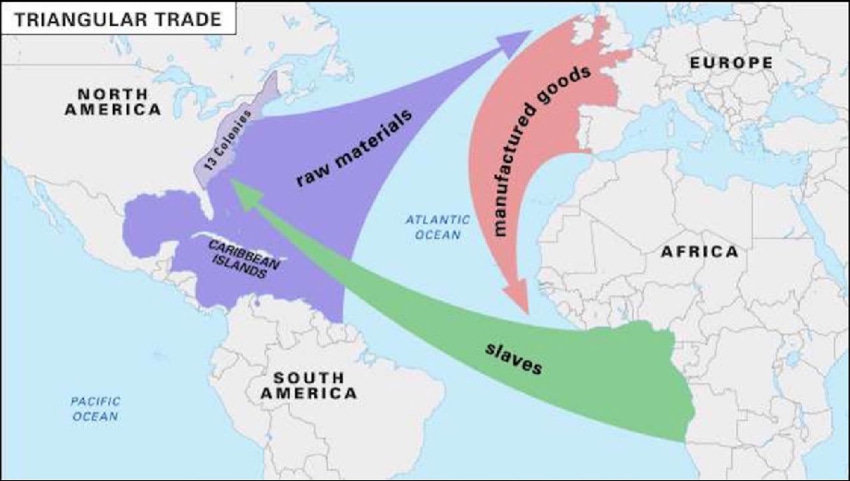
Human beings have practiced slavery for thousands of years around the world, but never to the scale observed in modern times, and never with such global consequences for the demographic composition of entire continents (see Figure 2). Slaves provided labor power to replace the massive demographic losses caused by the European arrival in the New World, as a result of recurring epidemics and large-scale warfare. Slaves also produced many of the critical raw materials, like cotton, which facilitated further economic development and industrialization back in Western Europe.4
The demographics of the African slave trade are shocking in their magnitude. The historian Patrick Manning estimated that roughly 12 million slaves from Africa were shipped to the Americas from 1500 to 1900.5 About 1.5 million of them died during the voyage itself, since conditions on the ships were absolutely horrific: cramped and dirty with disease roving around everywhere. That meant about 10.5 million people made it the other side of the Atlantic alive, although many of these individuals would end up dying within a few weeks and months of their arrival.
In addition to the African slave trade, Manning estimates that about 6 million slaves in total were sent to the Middle East, mostly to the Ottoman Empire, and to other parts of Asia. Some 8 million slaves were traded within Africa itself, and about 4 million Africans died as a result of slave raids, forced marches, famine, and disease. These numbers are all historical guesswork and the real figures could be much higher. But they highlight the global scale of modern slavery and the extent to which that scale substantially shifted the demographic composition of so many territories, colonies, and countries.
The Atlantic System controlled by the Europeans became the political and economic engine for this massive forced transfer of human beings. Europeans would bring manufactured goods like guns and textiles to Africa and trade those goods for enslaved people. The slaves were then shipped across the Atlantic to the Americas, where they worked under brutal conditions producing commodities and raw materials for European manufacturing, which then flowed back to Africa, completing the circle of evil and domination. Apologists for colonialism and imperialism overemphasize the role that Africans themselves played in seizing and kidnapping the slaves that they sold to the Europeans. But the only reason why this historical phase happened in the first place is because the Europeans provided the demand. Without that overwhelming demand, there would be no Atlantic slave trade. The key piece of evidence for this argument is that the scale of African slave raiding was sharply smaller before the arrival of Europeans in the 15th and 16th centuries. Historians have estimated that roughly 7 million African slaves were traded across the Sahara Desert from 800 to 1900, a period of over a thousand years.6 By contrast, Europeans smashed through that benchmark in just 400 years, as indicated by the numbers above.
Imperialism in Latin America: On Revolving Doors and Immigration Boomerangs
The history of US imperialism in Latin America is outrageously long and could cover multiple volumes to the Moon and back. Capitalism in the United States has always been a black hole sucking up the cheap labor of the Western Hemisphere, and the examples are legion, but nowhere is this dynamic clearer than with Mexico, which has always provided a steady labor supply for the needs of US capital. In the Bracero program from the 1940s to the 1960s, the United States brought in millions of Mexican workers to staff various economic sectors facing severe labor shortages during and after World War II. But US policy towards Mexican labor, and migrant labor in general, has always operated on a revolving door principle: bring them in when necessary, kick them out when politically convenient. The US government deported over a million Mexican workers in 1954 following a recession triggered by the end of the Korean War.7 This basic dynamic has repeated across time for all migrants who have come to the country, Mexican or not.
One of the lesser known effects of US imperialism, however, is that it inadvertently creates the conditions for migration through its aggressive imperial policies, a kind of boomerang effect that fully echoes the law of unintended consequences. By routinely sabotaging and destabilizing governments and economies across Latin America, the United States has ensured that the region remains impoverished, relatively deindustrialized, and structurally incapable of providing a decent life for its citizens. Unsurprisingly, the result of all this imperial devastation has been that millions of people in Latin America end up fleeing north in search of a better life, a recurring consequence in modern history.
In the 1950s, the United States overthrew Jacob Arbenz, the elected leader of Guatemala. Arbenz had been pursuing a modest policy of land reform and redistribution meant to give more productive agricultural land to poor peasants. But the United Fruit Company, the corrupt American monopolist that was in charge of the country, didn’t want anyone messing with that land, so it convinced Washington to stage a coup. For American officials in the Eisenhower administration, even marginal attempts at reform in Latin America smacked of communism, so naturally Arbenz had to be removed from power.8 Arbenz’s policies were reversed shortly after the coup, and the high-quality land which had been distributed to half a million peasants was suddenly back in the hands of wealthy elites and foreign corporations. That didn’t go down well with the Guatemalan working class, and eventually Guatemala descended into a civil war that would last almost three decades. The chaos and devastation caused by the civil war prompted some 200,000 Guatemalans to flee north and head to the United States by 1990.9 This wasn’t the first time that US imperialism in Latin America caused widespread migration and displacement, and it wouldn’t be the last.
In the 1980s, the United States funded and trained numerous right-wing armies, paramilitary groups, and insurgents across Latin America, fueling gruesome civil wars that collectively forced hundreds of thousands of people to flee to the United States itself. Nicaragua and El Salvador were both devastated by right-wing death squads and paramilitary bandits as the United States actively sabotaged left-wing forces and governments that it believed harbored communist tendencies.10 In the late 1970s, there were roughly 30,000 Salvadorans in the United States. By 1990, that number had soared to over 450,000, a stunning 1400% increase, as people fled the brutality of the Salvadoran Civil War in droves.11 Likewise, there were a few thousand Nicaraguans in the United States in the late 1970s, but that number had swelled to about 170,000 by 1990 as desperate civilians fled the violence for other safe havens in the Americas.
South America has not been spared either. Venezuela was in the news recently after the United States attacked the country in early January and kidnapped its sitting president. The decline of the Venezuelan state over the past decade is a classic example of neo-imperialism at work. When Maduro came to power after Chavez died, the Venezuelan economy was generally stable, though far from perfect. But in 2014, global oil prices crashed in response to the shale revolution in the United States, which produced a global supply glut, and declining demand from the European Union and most importantly from China, where Xi Jinping steered the country towards a direction of lower growth rates.12 Since Venezuela was heavily dependent on oil exports for its budget and for obtaining dollars, the falling oil prices really hurt the Venezuelan economy, sending it into recession. But it was US foreign policy that ultimately tipped Venezuela over the edge and caused a massive crisis.
When Trump first came to power in 2017, he proceeded to impose brutal sanctions on Venezuela that effectively tanked the country’s economy, leading to a full-blown depression. Venezuela’s foreign trade volume collapsed, and the country even had trouble obtaining critical life-saving medicine for its people. The sanctions alone are estimated to have directly and indirectly killed tens of thousands of Venezuelans in 2017 and 2018 alone.13 Facing few economic prospects at home, millions of Venezuelans eventually fled their country in the next few years. Since 2016, nearly a million of them would end up migrating to the United States, the same country that had caused the miserable economic conditions responsible for their initial departure.14
For the ruling classes in the United States, Latin America has always been seen as a source of cheap labor and cheap resources. At the same time, capital also recognizes that Latin American migrants provide a useful political foil in troubled economic times. As a result, there’s a perennial revolving door in migration dynamics for the United States, with immigrants allowed to come into the country in large numbers when economic times are good and then expelled and deported when economic times get rough and capital needs a way of assuaging popular working class anger, which is what’s happening nowadays with the Trump administration’s aggressive deportation push.
British Imperialism and Global Labor Transfers
From 1840 to 1940, over 100 million people migrated around the world.15 The rise of industrialization and the hyper-imperialism of the 19th century instigated massive global migration flows, as Europeans scrambled to snatch and extract all the natural resources and raw materials they could possibly find to fuel and grow their economies back home. Soaring demand for resources like rubber, tin, sugar, cotton, and guano produced massive population flows within Africa and Asia, but also outside them.
When the British Empire abolished slavery in the 1830s, Caribbean plantations faced a labor shortage and the imperial administration decided to grab cheap labor from China and India instead, so that resource extraction in Latin America and the Caribbean could continue without interruption.16 In effect, indentured servitude became the new slavery, as these workers were brutally exploited, paid like dirt, and often died early from disease and exhaustion. This global labor transfer became known as the “coolie trade” and led to millions of Asians being shipped, often under false pretenses, to the Western Hemisphere between 1834 and 1920. That’s the main reason why, to this day, there are large Chinese communities in places like Jamaica, the Dominican Republic, and Trinidad & Tobago. Likewise, over 1 million Indians were transported by the British to the Pacific and the Caribbean, altering the demographic and cultural landscape of many islands where they previously had no presence.17
The horrors and tragedies of British imperialism were not exclusively confined to colonial territories outside of Europe. In the middle of the nineteenth century, the Great Irish Famine killed roughly one million people and forced roughly two million others to emigrate, reducing Ireland’s overall population by about a quarter.18 In the popular imagination today, most people understand the Irish Famine as a tragic yet isolated disaster, an unfortunate one-off. But it’s not that hard to show, as many historians have done, that it was actually a catastrophic tragedy engineered by imperialism.
The famine started from a potato blight, which is an invasive kind of microbe, that devastated harvests across the island. Ireland had been struck by potato blights before, but it never experienced the kind of calamity it was about to endure. What made the famine truly apocalyptic was Ireland’s precarious position within the British imperial system. For the British elite, Ireland was just another economic vassal that could be readily squeezed for profits and resources.
The British aristocracy controlled vast stretches of grazing land across Ireland, which had been invaded and conquered during the Middle Ages. The cattle raised on this land provided a steady supply of beef for British consumers back on the mainland. But the expansion of grazing land for cows also forced many poor Irish people into smaller plots of land with dubious agricultural value. To compensate for decreased soil quality, Irish farmers increasingly turned to growing potatoes, a reliable and calorie-dense crop.19 The potato was originally grown by indigenous Americans, but European merchants eventually brought it back home and its popularity took off. When the potato blight struck in the 1840s and food prices started soaring, millions of poor peasants and farmers in Ireland were priced out of the market.
The British government responded to the unfolding tragedy through callous indifference. British officials in charge of the crisis believed that a market-based, laissez-faire approach would solve the problem. The theory went that the government did not need to intervene or provide much aid relief because the price mechanisms of the market would take care of everything. During similar crises in the past, the British had curtailed all food exports from Ireland as a way of keeping more food on the island. But they shamefully refused that option this time around, allowing vast amounts of food to depart the island.
As the situation grew worse in Ireland and domestic pressure in Britain intensified, the government reversed course and started to provide relief. But the relief was simply a Trojan horse to seize the land of poor farmers, exemplified by the so-called Gregory Clause in the 1847 Poor Law Amendment Act.20 In this legislation, the British government stipulated that Irish people who owned more than a quarter of an acre in land could not receive relief, like food and work. This provision, and others like it, forced hundreds of thousands of Irish people to sell their plots of land to corrupt landlords simply so they could receive basic relief to survive. After seizing the land, the landlords predictably started charging sky-high rent prices as a way of profiting from the tragedy. A major figure in charge of famine relief was Charles Trevelyan, the Assistant Secretary to the Treasury, who wrote the following about the Irish people and the ongoing famine:
The real evil with which we have to contend is not the physical evil of the Famine, but the moral evil of the selfish, perverse and turbulent character of the people.21
Trevelyan also wrote to Lord Monteagle that the famine resulted from the “direct stroke of an all-wise and all-powerful Providence.” In 1848, The Economist clamored for the “departure of the redundant population” as a necessary step for Ireland to become a more profitable part of the Empire.22 For the British elite, Ireland was just a large reserve for cattle grazing, and its people were a hindrance preventing the full exploitation of the land.
The Great Famine started off as a problem of nature, but near-genocidal levels of social engineering from the British ruling classes turned it into a human catastrophe. Indeed, many historians have actually called it a genocide, arguing that the British wanted poor Irish people to die in droves so that the aristocracy could seize more empty parcels of Irish land.23 The famine left a deep and bitter scar on Irish psychology, providing the base of anger and resentment that eventually culminated in a successful push for independence during the early twentieth century.
The consequences of Britain’s imperial past have persisted through to modern times. Today, politicians like Nigel Farage exploit immigration as a political issue, but there was a time when the British needed immigrants to keep their economy going. After World War II, Britain faced enormous labor scarcities, like many other countries. The Atlee government passed the British Nationality Act in 1948, which granted all imperial subjects the status of “Citizen of the United Kingdom and Colonies.”24 The Act allowed many British colonial subjects to come to the mainland so they could provide a stable labor supply, epitomized by the 1948 arrival of HMT Empire Windrush at the Port of Tilbury near London while carrying about 1,000 passengers. The new arrivals became known as the Windrush generation.
As Britain ran into economic headwinds in the 1960s and 1970s, the government changed its strategy towards curtailing immigration once again. We see here another major example of how immigration, like free trade or any other professed principle, has become a convenient political foil for the Western ruling classes. Immigrants are allowed in when economic times are good, but when capitalists screw up the global economy and leave the rest of us fighting for scraps, immigrants suddenly become the enemy and have to be banished at all costs. During economic recessions and the cyclical crises of capitalism, the political message from the ruling classes is always that immigrants need to go, not that capitalism needs to go, or at the very least not that it has to change in any real sense.
The Conservatives won the 1970 general election in large part on the promise to end and prevent mass migration from non-white groups. In the following year, the Heath government passed the Immigration Act of 1971, which further undid the reforms of 1948 and created a new “right of abode” for those who had parents or grandparents born in the UK.25 This new standard for so-called patrials created a racialized system, as most Commonwealth residents in places like Canada or Australia had an immediate ancestor born in the UK while most residents in the Caribbean, for example, did not. The 1971 act was the culmination of increasing economic anxiety in Britain during the late 1960s, epitomized by the notorious “Rivers of Blood” speech from MP Enoch Powell in 1968, when he warned of a racial war if Britain didn’t halt non-white immigrants from coming to the country.
The effects of the 1971 law, and a later immigration law passed in 1981, are still felt in so many different ways. For example, in 2018, the Windrush scandal exposed the bureaucratic incompetence of the British immigration system, as the 1971 law had changed the status of the Windrush generation but had not provided any documentation to substantiate their citizenship status.26 As a result, the British government under the Conservatives demanded proof-of-citizenship that many people from the Windrush generation simply could not provide, leading the government to actually expel many of these people from Britain. A massive PR scandal followed, which revealed the incompetence of the British state and the extent to which immigration has become a political football in modern British society.
Immigration in Britain today has become a major political issue for the same basic reasons it has done so in the United States: it’s a convenient distraction for the ruling classes to avoid talking about the failures of capitalism. But there’s another deep problem at play as well. Both Britain and the United States are declining powers in the new emerging global order characterized by increasing economic multilateralism. Their history of migration was deeply wrapped up in their history of imperialism. The fundamental reason why so many people from around the world ended up in places like Britain and the United States is because these countries were imperial hydras that needed a steady supply of cheap labor to keep their economic systems going. But now that they no longer control the global system the way they once did, their politicians and capitalists are increasingly turning against the very globalization that these countries themselves created. Free trade and immigration were apparently desirable when the West was on the top of the world, but now that things are heading south, these forces of the modern world have become targets on the right, a source of constant political controversy and a reliable political methodology for scaring the working class into making opportunistic and short-sighted decisions about its future. The biggest threat to the Western working class is not immigration, it’s imperialism and capitalism. Immigration dynamics are merely a side effect of imperial capital pulling the strings of the global economy.
Imperialism and Land: How Property Theft Affected Migration Dynamics
From the enclosures in England to the Land Code of 1858 in the Ottoman Empire, imperial powers have always adjusted, stolen, manipulated, and shifted property rights around as a way of controlling the labor power of their working classes. The proletarianization of the English peasant in the early modern period as a result of successive parliamentary enclosures, peaking in intensity from the mid-18th to the early 19th century, is a well-known and rigorously documented story.27 As a result, I will instead focus on a much more fascinating case study that’s less well-known in the Western world: the Ottoman Land Code of 1858.
In the 1830s, the Ottoman Empire instituted the policy of Tanzimat, meaning “reorganization,” as a way of attempting to modernize and catch up to the Western European powers. One of the most consequential reforms of the Tanzimat era was the Land Code of 1858, which fundamentally reshaped property rights across the Balkans and the Middle East, with its aftershocks still being felt today.28 Before modern times, property rights were often customary, especially for peasants and poor farmers. For example, a typical European farmer in the Middle Ages didn’t have a formal written deed saying that these two selions right here belonged to him. It was understood through social customs, local agreements, village discussions, and lord-vassal hierarchies that certain pieces of land could only be used by certain people. But the modern world, with its extensive legal standards and bureaucratic micromanagement, changed all that.
The Ottoman Land Code required peasants to register their land in exchange for a tapu, or deed. However, many peasants refused to do so precisely because they knew that formal registration would mean military conscription and heavy taxation. As a result, wealthy nobles from the cities rushed in and registered that land in their own names instead, in effect stealing land that had belonged to others for generations and centuries, even if these third-party registrations often happened by agreement with the peasants themselves. Many peasants became landless sharecroppers following this landgrab, and they were practically forced to relocate to major cities like Istanbul in search of wage labor.
These changes heavily impacted other peoples across the empire. Local migrations proliferated among nomadic groups like the Bedouins and the Kurds, which were forced to settle down on specific plots of land as a result of the Land Code.29 The Ottoman Empire also relocated millions of Circassian refugees fleeing from Russia throughout the Middle East, often using the excuse of “vacant” lands that were unregistered to anyone for the relocation process, even though these lands were most definitely being used by actual peasants engaged in seasonal grazing and subsistence farming.
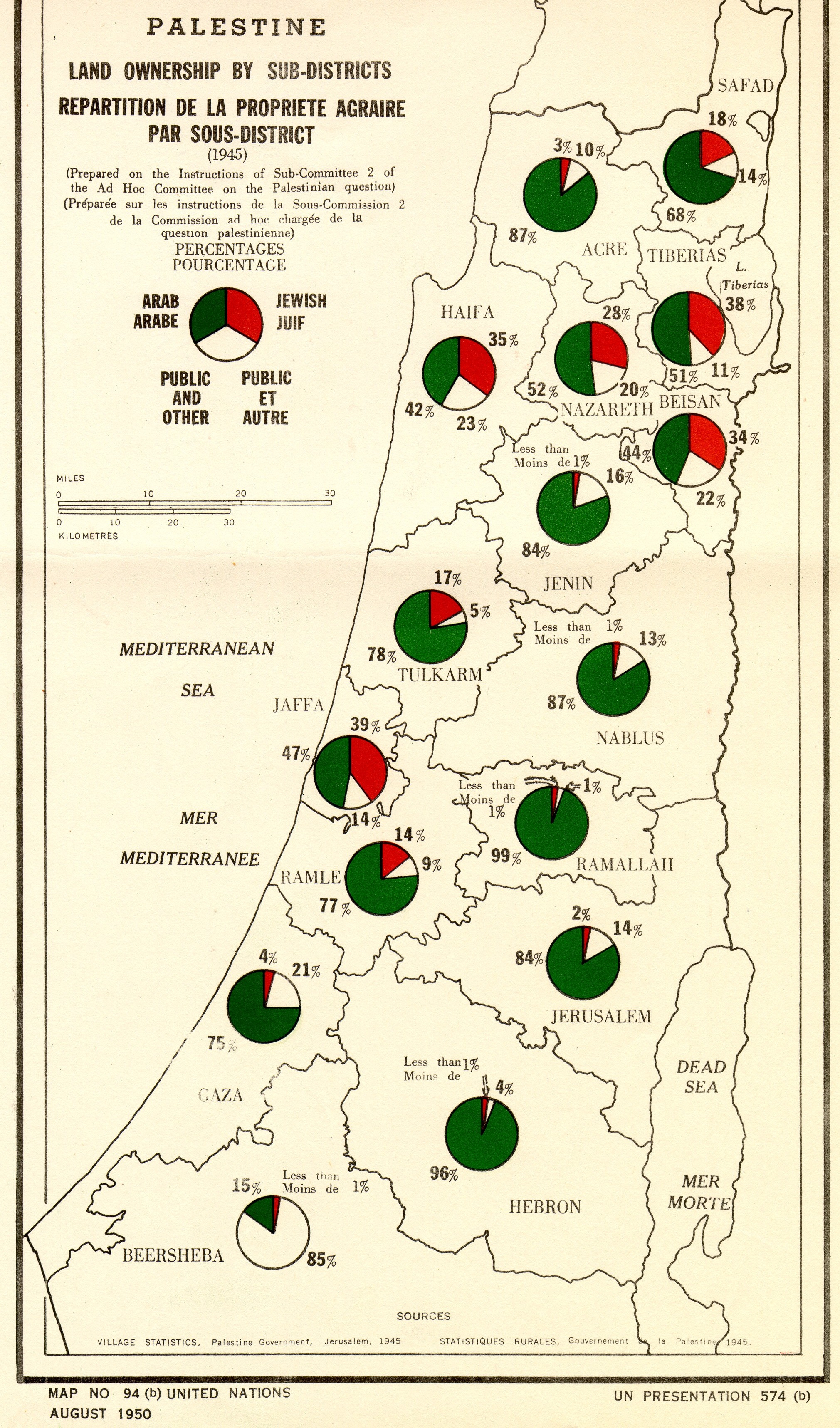
In a very powerful sense, the Ottoman Land Code of 1858 was the original sin that turbocharged the modern Israeli-Palestinian struggle. For the reasons cited above, many indigenous Palestinian farmers and peasants refused to formally register traditional land in their own names and had it registered to wealthy coastal merchants instead. When Jewish and Zionist organizations later came to the region looking for land, they bought these properties directly from the merchants, completely bypassing the Palestinian farmers and increasingly shifting the distribution of land ownership towards the Jews over time, even if they only held a minority of the land (see Figure 3). For an infamous example, the Sursock family of Beirut sold roughly 240,000 dunams in the fertile Jezreel Valley to Zionist groups and organizations in the early 1920s, leading to the eviction of thousands of Palestinian peasants.30 This land transfer sparked one of the first major waves of internal Palestinian displacement, culminating with entire generations of landless Palestinian peasants and fueling the conditions of political hostility which exploded into outright war later in the 20th century.
The formula for the landgrabs of the Tanzimat was repeated throughout the world in the modern period. First, require peasants to provide written deeds and proofs of ownership that they simply didn’t have. Second, seize their land once they couldn’t provide the new arbitrary proof demanded by the authorities. And third, turn them into wage laborers, where they could either provide a source of cheap labor on large consolidated farms or in urban factories for industrial production. In Australia, the notorious doctrine of Terra Nullius was used by settlers to declare Aboriginal land as legally vacant, justifying mass violence and displacement on a continental scale.31 Similar kinds of sordid events materialized all around the world at the intersection of imperialism and indigenous land practices, often leading to organized genocides and massacres.
Conclusion
Mass migration is a costly result of empire, and its effects on political and economic life worldwide have been pervasive and multidimensional. Empires themselves produce migration to their core territories when it suits them, then they turn against it when it becomes momentarily inconvenient. Empires also scramble migration dynamics worldwide, causing people to leave ancient homelands and settle in new territories, sparking numerous wars and social conflicts along the way.
What political conclusions can we reach from this analysis? There are several.
For the left, it’s that any domestic social, political, or economic problems that may be caused by immigration are largely downstream of more fundamental geopolitical relations and hierarchies in the global system. This makes the importance of class and political struggle on a global basis all the more necessary, as local solutions to the problems caused by migration are mere bandages on a deep wound. And for the working class in any given Western nation, it’s important to emphasize political engagement, labor agitation, union building, and solidarity in the face of capital’s attempts to undermine its position by exploiting immigration as a Trojan Horse.
And there’s an important lesson for the right here as well. What the right needs to understand is that you can have a global empire or a homogeneous ethnostate, but you cannot have both. No powerful empire or superpower in history has ever managed such a feat, and the United States is not about to buck that trend. In modern times, empire necessarily leads to the mixing of populations because establishing and reinforcing an empire requires control over the world’s labor supply and the broader political and economic architecture of capital accumulation, including global reserve currencies and military bases.
For those who love humanity and want something better than the status quo, the ultimate imperative is clear: let’s end imperialism, and human beings will no longer be forced to uproot their lives and communities. None of this means, of course, that we shouldn’t encourage migration for other reasons beyond imperialism. Immigrants can provide numerous benefits for any society, including cultural diversity, entrepreneurial innovation, economic mobility, and political flexibility. And even if we do end imperialism and capitalism, their ultimate ecological impacts via global warming and other biophysical vectors may still cause large volumes of global migration for decades if not centuries to come. These are all very critical issues in their own way, though they are not the main focus of this post.
The central lesson we need to internalize is that, especially in modern times, the global movement of peoples is largely dictated by the structural demands of the imperial core. The political struggle against imperialism is therefore a necessity that will liberate the working classes of the entire world, not just from forced migration, but from all the heinous depredations of capitalism.
For the classic exposition of the argument, see Saskia Sassen, The Mobility of Labor and Capital: A Study in International Investment and Labor Flow (Cambridge: Cambridge University Press, 1990).
See Immanuel Wallerstein, World-Systems Analysis: An Introduction (Durham: Duke University Press, 2004). Also see V. I. Lenin, Imperialism: The Highest Stage of Capitalism (Eastford: Martino Fine Books, 2011).
National Agricultural Workers Survey, U.S. Department of Labor, https://www.dol.gov/agencies/eta/national-agricultural-workers-survey.
For a comprehensive treatment of the subject, see Joseph E. Inikori, Africans and the Industrial Revolution in England: A Study in International Trade and Economic Development (Cambridge: Cambridge University Press, 2002).
Patrick Manning, “The Slave Trade: The Formal Demographics of a Global System,” in The Atlantic Slave Trade: Effects on Economies, Societies, and Peoples in Africa, the Americas, and Europe, eds. Joseph E. Inikori and Stanley L. Engerman (Durham: Duke University Press, 1992).
See Ralph A. Austen, “Trans-Saharan Slave Trade,” Oxford Research Encyclopedia of African History, 2024.
Mae M. Ngai, Impossible Subjects: Illegal Aliens and the Making of Modern America (Princeton: Princeton University Press, 2014).
Stephen Schlesinger and Stephen Kinzer, Bitter Fruit: The Story of the American Coup in Guatemala (David Rockefeller Center for Latin American Studies, 2005).
Diego Chaves-González, Esther Jiménez Atochero, and Jeanne Batalova, “Guatemalan Immigrants in the United States,” Migration Policy Institute, May 14, 2025. https://www.migrationpolicy.org/article/guatemalan-immigrants-united-states.
Greg Gandin, The Last Colonial Massacre: Latin America in the Cold War (Chicago: Chicago University Press, 2011).
Aaron Terrazas, “Salvadoran Immigrants in the United States in 2008,” Migration Policy Institute, https://www.migrationpolicy.org/article/salvadoran-immigrants-united-states-2008.
Marc Stocker, John Baffes, and Dana Vorisek, “What triggered the oil price plunge of 2014-2016 and why it failed to deliver an economic impetus in eight charts,” World Bank, January 18, 2018. https://blogs.worldbank.org/en/developmenttalk/what-triggered-oil-price-plunge-2014-2016-and-why-it-failed-deliver-economic-impetus-eight-charts.
Mark Weisbrot and Jeffery Sachs, “Economic Sanctions as Collective Punishment: The Case of Venezuela,” Center for Economic and Policy Research, April 25, 2019.
Jeffrey S. Passel and Dalia Fahmy, “7 facts about Venezuelans in the US,” Pew Research Center, January 9, 2026. https://www.pewresearch.org/short-reads/2026/01/09/facts-about-venezuelans-in-the-us/.
Adam McKeown, “Global Migration and Regionalization, 1840-1940,” paper for conference on Mapping Global Inequalities, 2007. https://escholarship.org/content/qt4t49t5zq/qt4t49t5zq_noSplash_95f73f6a685393fac7d7641da9e81507.pdf.
See Elliott Young, Alien Nation: Chinese Migration in the Americas (Chapel Hill: University of North Carolina Press, 2014). Also see, Arnold J. Meagher, The Coolie Trade: The Traffic in Chinese Laborers to Latin America, 1847-1874 (Bloomington: Xlibris Publishing, 2008).
Hugh Tinker, A New System of Slavery: The Export of Indian Labour Overseas, 1830–1920 (London: Oxford University Press, 1974).
The Great Irish Famine Online, Geography Department, University College Cork. https://ucc.maps.arcgis.com/apps/MapSeries/index.html?appid=83617870f2624735b4f5cae21077ea36.
Cecil Woodham-Smith, The Great Hunger: Ireland 1845-1849 (New York, Penguin Group, 1992).
Christine Kinealy, This Great Calamity: The Irish Famine 1845-52 (Dublin: Gill Books, 2006).
Lee Boldeman, The Cult of the Market: Economic Fundamentalism and Its Discontents (Canberra: ANU Press, 2007), 25.
Michael J. O’Sullivan, Ireland and the Global Question (Syracuse: Syracuse University Press, 2006), 56.
For the most famous prosecutor of the genocide argument, see Tim Pat Coogan, The Famine Plot: England’s Role in Ireland’s Greatest Tragedy (New York: St. Martin’s Press, 2013).
UK Legislation, British Nationality Act of 1948, https://www.legislation.gov.uk/ukpga/Geo6/11-12/56/introduction/enacted?view=plain.
UK Visas and Immigration, Historical background information on nationality, https://www.gov.uk/government/publications/historical-background-information-on-nationality/historical-background-information-on-nationality-accessible.
Amelia Gentleman, “Chased into self-deportation: the most disturbing Windrush case so far,” The Guardian, September 14, 2019. https://www.theguardian.com/uk-news/2019/sep/14/scale-misery-devastating-inside-story-reporting-windrush-scandal.
See E. P. Thompson, The Making of the English Working Class (New York: Vintage, 1966). For a classic paper on the impact of enclosures on proletarianization, see also Jane Humphries, “Enclosures, common rights, and women: The proletarianization of families in the late eighteenth and early nineteenth centuries,” The Journal of Economic History, vol. 50 (1990): pp. 17-42.
For a regional analysis focused on Palestine, see Ruth Kark, “Consequences of the Ottoman Land Law: Agrarian and Privatization Processes in Palestine, 1858-1918,” in Societies, Social Inequalities and Marginalization, eds. Raghubir Chand, Etienne Nel, and Stanko Pelc (New York: Springer Nature, 2017).
Eugene L. Rogan, Frontiers of the State in the Late Ottoman Empire: Transjordan, 1850–1921 (Cambridge: Cambridge University Press, 2002).
Mark Tessler, A History of the Israeli-Palestinian Conflict (Bloomington: Indiana University Press, 1994), 177. A dunam is roughly 900 square meters.
Sven Lindqvist, Terra Nullius: A Journey Through No One’s Land (New York: The New Press, 2007).
Great to see good analysis of immigration through the imperial and structural lens! I do think care is warranted in overstating some aspects of the argument though.
In particular, seeing global movement as "dictated" by the demands of the imperial core both undersells the agency of those who migrate and oversells the intentionality of the processes involved.
It's important that these narratives ring true with those it talks about. For example, while low wage labour is higher among immigrants in the imperial core, a good two thirds of immigrants in the US earn a middling salary or above. Trying to convince people they are forced migrants when they feel otherwise doesn't seem a productive avenue. https://immresearch.org/wp-content/uploads/Final-National-Earnings-Ranges.pdf
When we look at the elites involved in immigration discourse and policy setting, usually different parts of the elite serve during the pro- and backlash immigrant phases. The UK is an interesting example there, as children of these migrants, like Rishi Sunak, Priti Patel, Suella Braverman, and Kemi Badenoch, get incorporated into the imperial management process. In this way competing aspects of the elite deliver the process as a whole, rather than it being premeditated or duplicitous. Flows of Afghan immigrants into the imperial core in recent years, for example, certainly looks like a result of path dependency rather than deliberate policy.
A good chunk of immigration is socially based too, and it's left unspoken the way the imperial processes shape familial, romantic, and communal desires.
While these things don't change the basic point of how modern empires benefit from managed flows of people, and how structural demands heavily influence migration, I think it does complicate the conclusions drawn.
Crushingly on point. Appreciate this. Why is it that every single time I read your work I want to have you back on the podcast to discuss. I learn so much from you.